
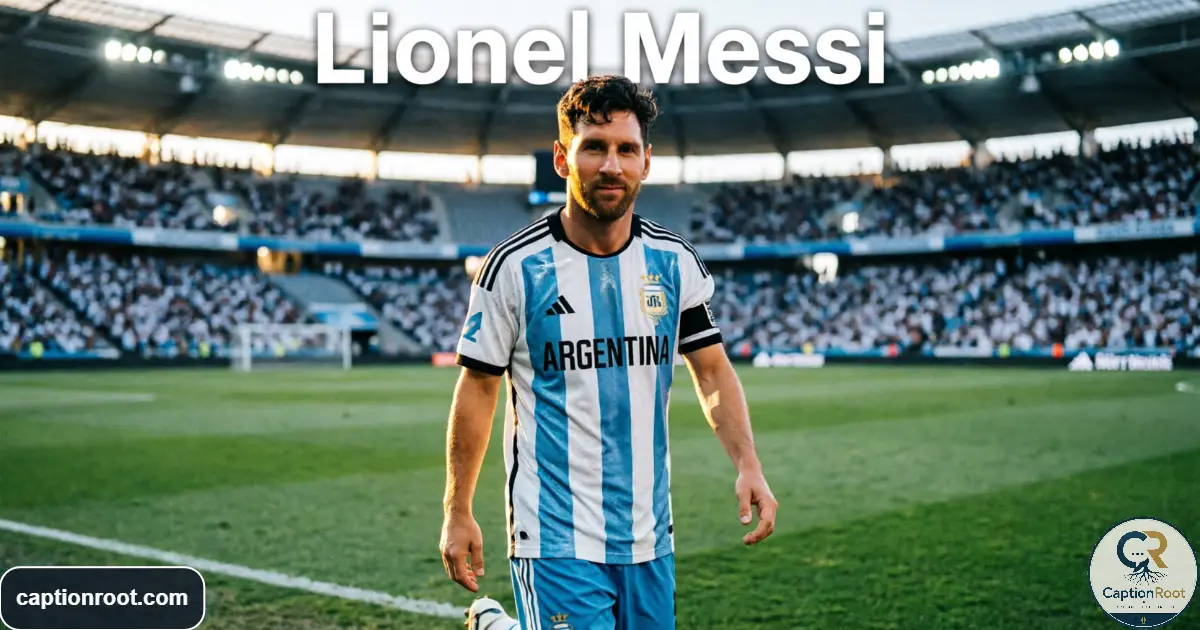
Lionel Messi has spent more than two decades turning extraordinary talent into one of football’s most decorated careers. From a young prospect in Rosario to Barcelona’s record goalscorer, Argentina’s World Cup-winning captain, and later Inter Miami’s No. 10, Messi’s story stretches across generations of the sport. Now 39, he remains an Inter Miami player but ended his Argentina career on August 31, 2026, following his sixth World Cup.
His legacy is bigger than any single statistic. It combines elite goalscoring, playmaking, trophies, longevity, individual awards, and an international journey that moved from painful final defeats to World Cup glory.
Lionel Messi at a Glance
Lionel Andrés Messi was born on June 24, 1987, in Rosario, Argentina. He is a left-footed forward best known for his close control, dribbling, creativity, finishing, and ability to create chances from spaces that appear closed.
As of September 2026, Messi is 39 and plays for Inter Miami CF as the club’s No. 10. Inter Miami lists him as a 5-foot-7 forward, while his contract runs through the end of the 2028 MLS season.
Quick facts
- Full name: Lionel Andrés Messi
- Date of birth: June 24, 1987
- Birthplace: Rosario, Argentina
- Age: 39
- Nationality: Argentine
- Height: 5 feet 7 inches
- Position: Forward
- Preferred foot: Left
- Current club: Inter Miami CF
- Club number: 10
- Ballon d’Or awards: 8
- World Cup titles: 1
- Argentina status: Retired from international football
- Inter Miami contract: Through the 2028 MLS season
Those facts provide the outline. The more interesting story is how Messi moved from a gifted child in Argentina to the center of some of football’s defining moments.
From Rosario to Barcelona
Messi’s football journey began in Rosario, where his talent was visible long before the global awards and stadium crowds arrived. He played in the youth system of Newell’s Old Boys before moving with his family to Spain as a teenager and joining FC Barcelona.
Barcelona became the environment where his game developed from exceptional youth talent into senior-level brilliance. His low center of gravity, unusually tight touches, balance and quick changes of direction made him difficult to stop even before his finishing and passing reached their peak.
Messi made his competitive senior breakthrough while still a teenager. What followed was not a short burst of potential but a long period of sustained dominance.
The move from Rosario to Barcelona matters because almost every major part of Messi’s football identity was shaped there. He became a goalscorer, creator, false nine, right-sided attacker and central playmaker while playing alongside several generations of elite teammates.
By the time he eventually left Spain, Barcelona and Messi had become almost impossible to discuss separately.
How Messi Became a Barcelona Legend

Messi’s Barcelona career is the foundation of his club legacy.
He spent 17 years with the senior side and became Barcelona’s all-time leading goalscorer. During that period, he helped the club win 10 La Liga titles, seven Copa del Rey trophies and four UEFA Champions League titles, although UEFA notes that he appeared in the winning Champions League finals in 2009, 2011 and 2015 and was not in the matchday squad for the 2006 final.
The numbers were exceptional, but Messi’s Barcelona years were about more than volume.
Under Pep Guardiola, particularly from 2008 onward, Barcelona built one of football’s most influential teams around technical control, movement and positional intelligence. Messi became the decisive attacking figure.
At different stages, he could start wide and attack inside, operate centrally as a false nine, drop between midfield and defense to create, or stay close enough to goal to punish a single positional mistake.
His 2011/12 league season remains one of the clearest statistical examples of his scoring peak. Messi scored 50 La Liga goals, which remains the competition’s single-season record. He eventually finished with 474 La Liga goals, also a record.
Then came 2012.
Across club and international football, Messi scored 91 goals in the calendar year, one of the most famous individual scoring marks in football history. UEFA records 79 of those goals at club level, with the Argentina goals bringing the total to 91.
His Barcelona career also produced 120 Champions League goals for one club, another UEFA-listed record.
Yet reducing those years to totals misses part of what made him different. Messi could control an entire match without staying in one fixed attacking role. He might score twice, create three major chances, carry the ball through midfield and still influence the game by drawing defenders away from teammates.
That combination of scorer and creator separated him from players who specialized in only one attacking function.
Why Messi Left Barcelona
Messi’s departure in 2021 was not presented as a simple football decision. Barcelona’s financial problems and league registration constraints prevented the club from completing a new deal under the circumstances at the time.
The result was one of the most emotional exits in modern football.
After spending most of his professional life at the same club, Messi joined Paris Saint-Germain in 2021.
PSG and Life After Barcelona
Paris Saint-Germain represented a major adjustment.
For the first time in his senior career, Messi had to adapt to a completely different club after leaving the system, city and environment that had defined him for nearly two decades.
He spent two seasons in France and won Ligue 1 twice.
His PSG spell never replaced Barcelona as the defining club chapter of his career, but it should not be ignored. It overlapped with one of the most important periods of his international career, including Argentina’s victory at the 2022 World Cup.
PSG also marked the final phase of Messi’s European club career.
In 2023, he left Paris and moved to the United States to join Inter Miami.
Lionel Messi at Inter Miami
Messi’s move to Inter Miami changed the scale of attention surrounding Major League Soccer almost immediately.
He arrived in 2023 and helped Inter Miami win the Leagues Cup during his first season. The club later won the 2024 Supporters’ Shield, and in December 2025 Inter Miami captured its first MLS Cup, with Messi providing two assists in the 3-1 final victory over Vancouver and earning MLS Cup MVP honors.
His Miami career has also shown how effectively his game has adapted with age.
The explosive acceleration of his early Barcelona years is naturally less central now. His vision, passing angles, positioning, finishing and set-piece ability allow him to control games without relying on constant high-speed movement.
That evolution was still visible in August 2026. Shortly after playing in the World Cup final, Messi scored four times and supplied an assist in Inter Miami’s 7-1 MLS win over CF Montréal. Reuters reported that the performance took him to 18 league goals for the season at that point.
Inter Miami had already secured his longer-term future before then. The club announced in October 2025 that Messi had signed an extension through the end of the 2028 MLS season.
The Miami chapter therefore should not be treated as a short retirement tour. It has become a meaningful part of his competitive career.
Argentina: From Heartbreak to World Champion

Messi’s Argentina career followed a much less straightforward path than his rise with Barcelona.
He made his senior international debut in 2005 after starring for Argentina at youth level. The expectations that followed were enormous, particularly because every elite Argentine attacker is inevitably measured against Diego Maradona.
Early major tournaments produced memorable performances, but also painful defeats.
Argentina reached the 2014 World Cup final and lost to Germany. Further disappointment came in Copa América finals, and after another defeat in 2016, Messi briefly announced that he was finished with international football.
He returned.
That decision eventually changed the emotional meaning of his Argentina career.
Copa América 2021
Argentina defeated Brazil in the 2021 Copa América final, giving Messi his first major senior international title.
For a player whose international career had often been framed around what he had not won, the victory changed the conversation.
World Champion in 2022
The biggest breakthrough came in Qatar.
Messi captained Argentina to the 2022 FIFA World Cup, scoring twice in the final against France before Argentina won the penalty shootout. UEFA also notes that he became the only player to win the World Cup Golden Ball twice.
This was the trophy that had remained missing even after years of club dominance and individual awards.
The tournament also transformed the wider narrative around Messi and Argentina. The story was no longer about whether he could reproduce club success for his country. He had led Argentina to football’s biggest title.
Copa América 2024 and the Final World Cup
Argentina followed the World Cup triumph by winning another Copa América in 2024.
Messi then reached the 2026 World Cup final in what became his sixth World Cup tournament. Argentina ultimately lost the final to Spain, but Messi finished his World Cup career with a remarkable collection of tournament records and milestones.
On August 31, 2026, he announced his retirement from international football.
He finished with 207 Argentina appearances and 125 goals, both national records, according to Reuters and UEFA.
The full arc makes his international career unusually compelling. There were years of criticism, lost finals, an initial retirement, a return, continental titles, a World Cup victory, another World Cup final and finally a farewell at 39.
Lionel Messi’s Biggest Records and Achievements
Messi’s career contains so many records that simply listing them can make their significance harder to understand. The most useful approach is to separate them by type.
Individual Awards
Messi has won a record eight Ballon d’Or awards, more than any other player. He has also won six European Golden Shoes.
His individual awards reflect both longevity and different versions of his game. Some came during explosive scoring seasons, while others recognized years in which his playmaking and overall influence were just as important.
La Liga Records
Messi’s Spanish league achievements include:
- 474 La Liga goals, the competition record
- 50 goals in 2011/12, the single-season record
- 36 La Liga hat-tricks
- 8 Pichichi awards
- 21 consecutive league matches scored in, the longest goalscoring streak listed by UEFA
These records are particularly significant because they were built across many seasons rather than one short peak.
Champions League Records
Messi finished his UEFA Champions League career with 129 goals in 163 matches, including 120 goals for Barcelona and nine for PSG.
Among his competition records are:
- most Champions League goals for one club: 120
- most group-stage or league-phase goals: 80
- most round-of-16 goals: 29
- five goals in one Champions League knockout match, a record he shares with Erling Haaland
He appeared in Champions League final victories in 2009, 2011 and 2015.
Argentina and World Cup Records
By the end of his international career, Messi held Argentina’s records for both appearances and goals.
UEFA lists:
- 207 Argentina appearances
- 125 Argentina goals
- 34 World Cup appearances
- 23 World Cup match victories
- goals in five different World Cup tournaments for Argentina
- two World Cup Golden Balls
- the distinction of scoring during the group stage, round of 16, quarterfinal, semifinal and final across World Cup competition
These records help explain why his legacy cannot be reduced to club football alone.
What Makes Messi’s Playing Style So Difficult to Defend?
Messi’s most recognizable technical trait has always been his ability to keep the ball extraordinarily close while moving at speed.
That matters because defenders normally rely on the attacker’s heavier touches to time a challenge. Messi’s touches often remain short enough that the ball stays within immediate control, allowing him to change direction before a defender can commit safely.
His low center of gravity also helps him turn sharply and absorb contact without losing balance.
But dribbling is only one part of the problem.
He Can Create or Finish
Many elite attackers force defenders to protect against one primary threat.
Messi presents several.
Give him space near goal and he can shoot. Close the shooting lane and he can slide a pass behind the defensive line. Commit a midfielder toward him and he can dribble into the space that movement creates.
That constant uncertainty is part of what makes defending him so difficult.
His Left Foot Shapes the Game
Messi strongly favors his left foot, yet predictability has rarely made stopping him simple.
He can use the same body position to disguise several different outcomes, including a curled shot, chipped pass, through ball, short combination or continued dribble.
His free-kick ability added another threat around the penalty area.
His Role Changed With Age
Young Messi could repeatedly attack defenders with explosive acceleration.
Later Messi became more selective.
He increasingly conserved movement, dropped deeper to receive the ball and relied on vision, timing and technical precision. Instead of trying to win every action through speed, he became better at choosing the moments that mattered.
That evolution is a major reason he remained decisive into his late thirties.
The Legacy Lionel Messi Leaves Behind

Lionel Messi’s place in football history rests on an unusually complete résumé.
At Barcelona, he became the club’s record scorer and the central attacking figure in one of the most successful periods in its history. In Europe, he accumulated Champions League records and individual honors. With Argentina, he turned a story once dominated by painful final defeats into one crowned by Copa América titles and the 2022 World Cup.
His later years added something else: longevity.
Playing at a sixth World Cup at age 39 and reaching another final showed that his international career did not simply fade after Qatar. His move to Inter Miami also created a new competitive chapter rather than an immediate conclusion.
Debates about the single greatest footballer will always depend partly on era, criteria and personal preference. What is harder to debate is Messi’s place in the smallest group of players who changed expectations for what an attacker could produce across goalscoring, creativity, trophies and longevity.
Conclusion
Lionel Messi’s career connects several football eras: the Barcelona academy graduate, record-breaking goalscorer, creative playmaker, Argentina captain, World Cup champion and veteran Inter Miami leader. The records matter, but the progression behind them explains his reputation more clearly. He kept adapting while remaining decisive.
His Argentina career is now complete, closing on August 31, 2026 after 207 appearances and 125 goals, but his club career continues with Inter Miami. For anyone trying to understand Messi’s legacy, the clearest takeaway is not one trophy or statistic. It is how long he remained capable of shaping the biggest matches in different ways.
Frequently Asked Questions
How old is Lionel Messi?
Lionel Messi is 39 years old. He was born on June 24, 1987, in Rosario, Argentina. Inter Miami’s official player profile lists his date of birth, birthplace and current position as a forward.
What team does Lionel Messi play for now?
Messi plays for Inter Miami CF in Major League Soccer. He wears No. 10 and is the club captain. His current contract runs through the end of the 2028 MLS season.
Is Lionel Messi retired?
Messi has retired from international football, but he has not retired from club football. He announced the end of his Argentina career on August 31, 2026, while remaining under contract with Inter Miami.
How many Ballon d’Or awards has Messi won?
Lionel Messi has won the Ballon d’Or eight times, the record for the award. His individual honors also include six European Golden Shoes and two FIFA World Cup Golden Balls.
How many World Cups has Lionel Messi won?
Messi won one FIFA World Cup, captaining Argentina to the title in Qatar in 2022. Argentina reached the final again at the 2026 World Cup but lost to Spain.
What clubs has Lionel Messi played for?
At senior professional level, Messi has played for FC Barcelona, Paris Saint-Germain and Inter Miami CF. He spent the vast majority of his European career at Barcelona before moving to PSG in 2021 and Inter Miami in 2023.
How many goals did Messi score in La Liga?
Messi scored 474 La Liga goals, the competition record. His 50 league goals in the 2011/12 season are also the record for most goals in a single La Liga campaign.
Why is Lionel Messi considered one of football’s greatest players?
The case rests on the combination of achievements rather than one statistic. Messi paired record-level goalscoring with elite playmaking, won eight Ballon d’Or awards, accumulated major club trophies, broke numerous scoring records and captained Argentina to the 2022 World Cup while sustaining elite performance across more than two decades.