
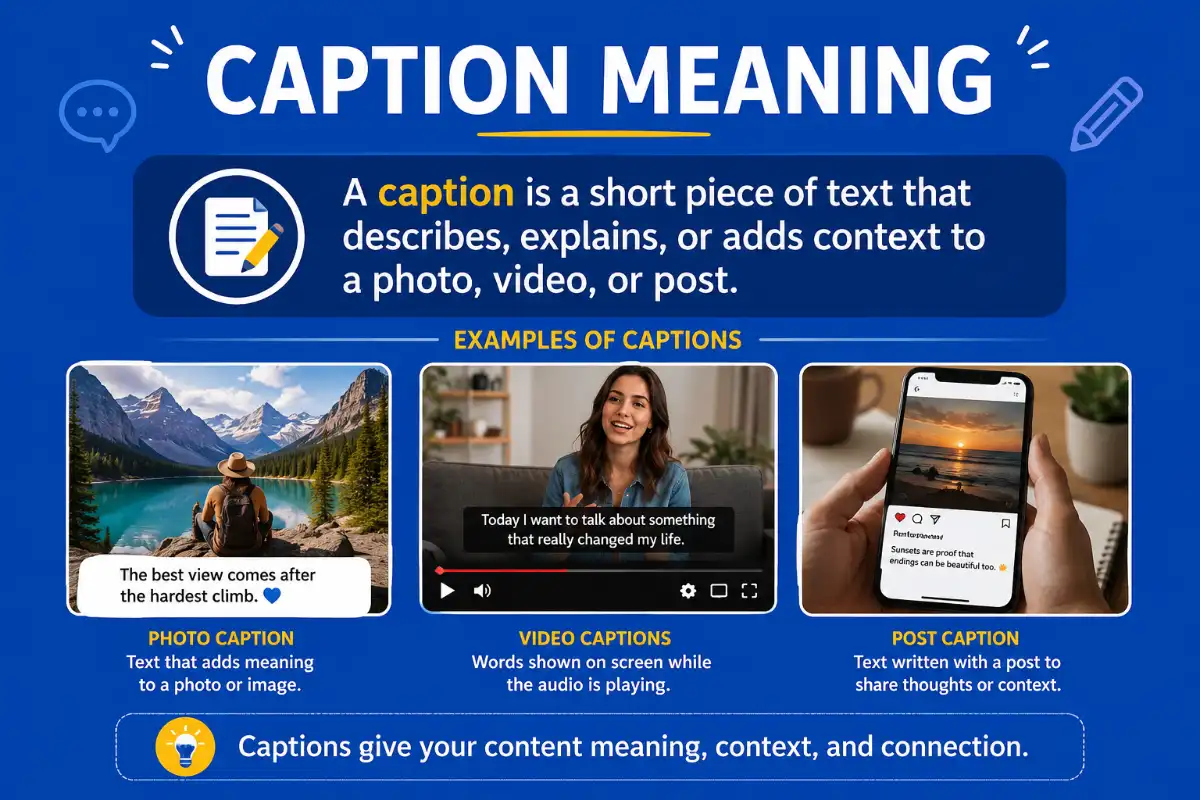
Captioned meaning usually refers to the meaning of the word captioned, especially when it appears with a photo, social media post, video, television program, or accessibility setting. In simple English, captioned means supplied with a caption or written text. That text may describe a picture, identify people or places, accompany a social post, represent spoken dialogue, or communicate meaningful sounds in video content.
However, the exact meaning depends on context. A captioned Instagram photo usually includes written copy that accompanies the post, while a captioned video may display synchronized speech as readable text. You will also see the word in journalism, publishing, television, TikTok, Reels, YouTube, text conversations, and meme culture.
Therefore, understanding what captioned means requires looking at both the medium and the purpose of the text. The examples below explain these different uses while also covering pronunciation, grammar, subtitles, transcripts, closed captions, open captions, and related words.
Captioned Meaning in Simple Words 📝
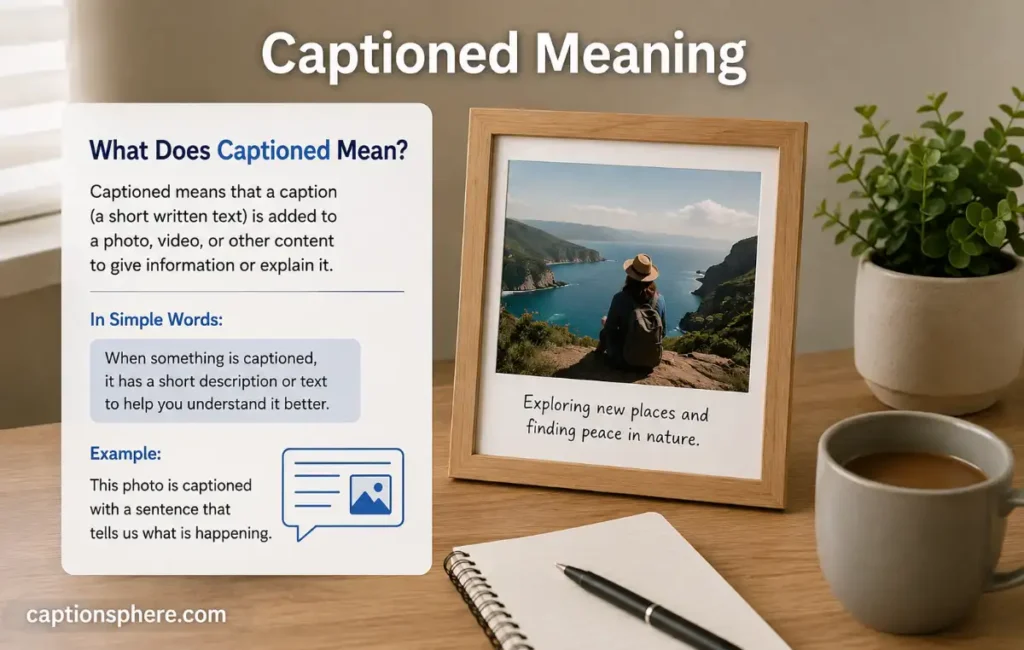
At its simplest, captioned means that someone has added a caption to something. The base word is caption. A caption can describe an image, explain a scene, identify someone, or accompany a social media post.
For example, a photographer might caption an image with a location, while an Instagram user might add a funny sentence to a selfie. Similarly, an editor might caption a historical photograph with a date and the names of the people shown.
Here are some everyday examples:
- The editor captioned the photo with the students’ names.
- She captioned her vacation picture with the beach location.
- He captioned the birthday photo with a thank-you message.
- The photographer added captions to every image in the album.
- The creator added captions before publishing the video.
- She captioned the sunset picture with a short reflection.
- The historian added the date beneath the old photograph.
- He captioned the group selfie with an inside joke.
- The designer added a brief explanation beneath each illustration.
- She captioned her graduation photo with a message about the future.
In other words, a caption is the actual text, while captioned describes the action or result of adding it. For example, Summer in Seattle may serve as a caption, while She captioned the photo “Summer in Seattle” describes what she did.
Captioned Meaning on Social Media 📱
On social media, captioned usually means that someone has added written copy to a photo, carousel, video, or another visual post. The caption might explain what happened, tell a short story, add humor, identify a location, express an emotion, or encourage followers to respond.
For instance, someone posting vacation photos might add details about the destination. Meanwhile, another person may caption a selfie with a joke or short quote.
Consider these examples:
- I captioned the beach photo with a memory from our trip.
- She captioned her birthday post with a message for her friends.
- He added the dish name to the caption of his restaurant photo.
- They captioned their travel carousel with notes from each stop.
- She added the important details to the announcement caption.
- He captioned the sunset post with a thoughtful sentence.
- She captioned her photo dump with a recap of the month.
- He added memories from the night to his concert post.
- They captioned their family photo with a holiday greeting.
- I wrote the caption before sharing the post.
However, this meaning differs from accessibility captions. A social media post caption accompanies the content, whereas accessibility captions usually represent speech and meaningful sounds inside a video.
Words such as labeled, described, annotated, titled, and identified may have related meanings. Still, they do not work as exact replacements in every situation.
Captioned Meaning on Instagram 📸
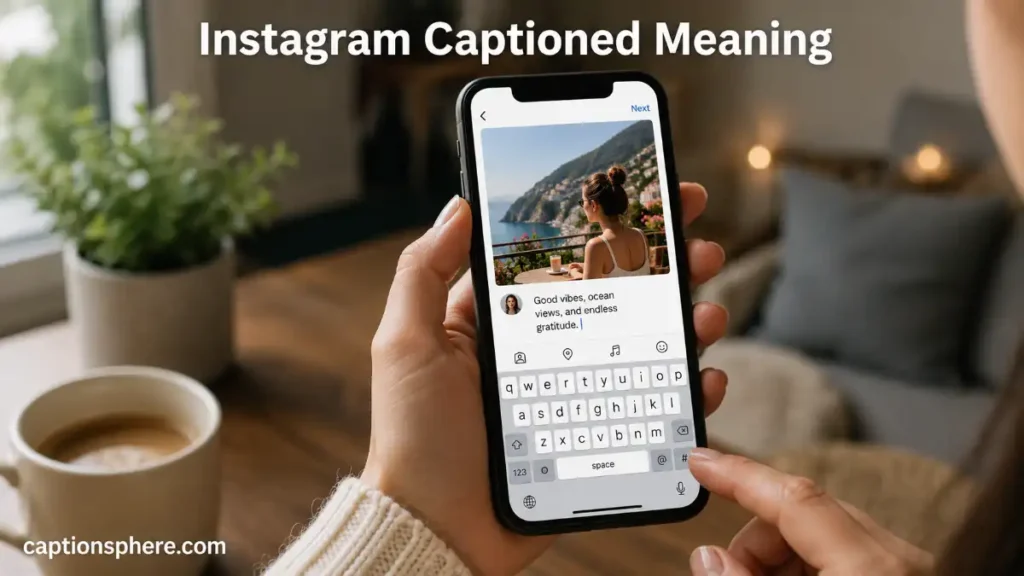
On Instagram, captioned generally means that someone has written text to accompany a feed photo, carousel, Reel, or other post. An Instagram caption can contain one word, several sentences, a personal story, a question, hashtags, or useful contextual information.
For example, people often mention the location, occasion, activity, or people shown in a photo. Others use captions to express a mood or give their followers more context.
Here are some common examples:
- She captioned her Instagram selfie with a joke about Monday.
- I captioned the carousel with highlights from the weekend.
- He captioned his gym photo with a note about his progress.
- They added a personal message to their anniversary picture.
- She captioned the café photo with the neighborhood name.
- I captioned my July photo dump with a short monthly recap.
- She added a message of gratitude to her graduation post.
- He captioned his concert pictures with memories from the show.
- She added details about the occasion to her outfit post.
- They captioned their engagement photo with the happy announcement.
You may also encounter the phrase “caption this.” It simply means write a suitable caption for this image or post. Likewise, “How would you caption this?” asks someone what words they would pair with the visual.
Captioned Meaning for Videos 🎬
When people talk about videos, captioned often refers to readable text that represents audio. Captions commonly show spoken dialogue and may also identify speakers or communicate meaningful sounds.
For example, a caption might display a person’s spoken sentence. Additionally, it may include information such as [music playing], [applause], or [door closes] when those sounds matter to the viewer’s understanding.
Here are several examples:
- The production team added captions so viewers could read the interview.
- We watched a captioned version of the documentary.
- The creator added captions throughout the tutorial.
- The captions identified each speaker in the recording.
- The editor added captions to the educational clip before publication.
- She uploaded a captioned version of her presentation.
- The announcement video included readable captions.
- The production team carefully captioned the recorded discussion.
- The livestream displayed captions throughout the event.
- The video included captions for dialogue and important sounds.
However, captioned and subtitled are not always identical. Subtitles commonly focus on spoken dialogue and often translate speech from one language into another. Accessibility captions, by contrast, may also identify speakers and communicate meaningful non-speech sounds.
Platform terminology can vary, so always consider the specific service or media format.
Captioned Meaning for Photos 🖼️

For photographs, captioned means that someone has attached or displayed written information with an image. A photo caption might identify people, mention a location, provide a date, describe an event, or explain what viewers can see.
You will commonly find captioned photographs in social media posts, family albums, museums, magazines, newspapers, blogs, and historical archives.
For example:
- The photographer captioned the wedding photo with the couple’s names.
- She added locations to each vacation photo.
- The historian captioned the old picture with the year it was taken.
- She captioned the family portrait with everyone’s names.
- The museum added background information beneath the photograph.
- He captioned the mountain photo with the trail name.
- She added the celebration date beneath the birthday picture.
- The archivist captioned each historical image individually.
- The editor added event details beneath the group photograph.
- He captioned the travel picture with its destination.
However, captioned also differs from labeled. A label usually identifies something briefly, whereas a caption can provide additional context.
For instance, Golden Gate Bridge works like a simple label. By comparison, Morning traffic crosses the Golden Gate Bridge under heavy fog functions more like a descriptive caption.
Captioned Meaning in Text Messages 💬
Captioned is not normally text-message slang. Instead, people generally use it with its standard English meaning when discussing a photo, post, meme, Reel, or video.
Therefore, the surrounding conversation usually tells you exactly what the speaker means.
Here are some natural chat examples:
- Did you see how she captioned that photo?
- I still haven’t captioned my vacation pictures.
- Why did you caption the selfie like that?
- I captioned it right before posting.
- She already added captions to every picture in the carousel.
- How should I caption this photo?
- You captioned that picture perfectly.
- They captioned the post with an inside joke.
- Have you captioned your graduation post yet?
- I finally captioned all the photos from our trip.
For example, if someone writes “I captioned this ‘new beginnings,’” they mean that they used new beginnings as the written caption for the image, video, or post.
So, unlike terms such as LOL, IDK, or IMO, captioned does not carry a special hidden meaning in texting.
Captioned Meaning for Reels and TikTok 🎥
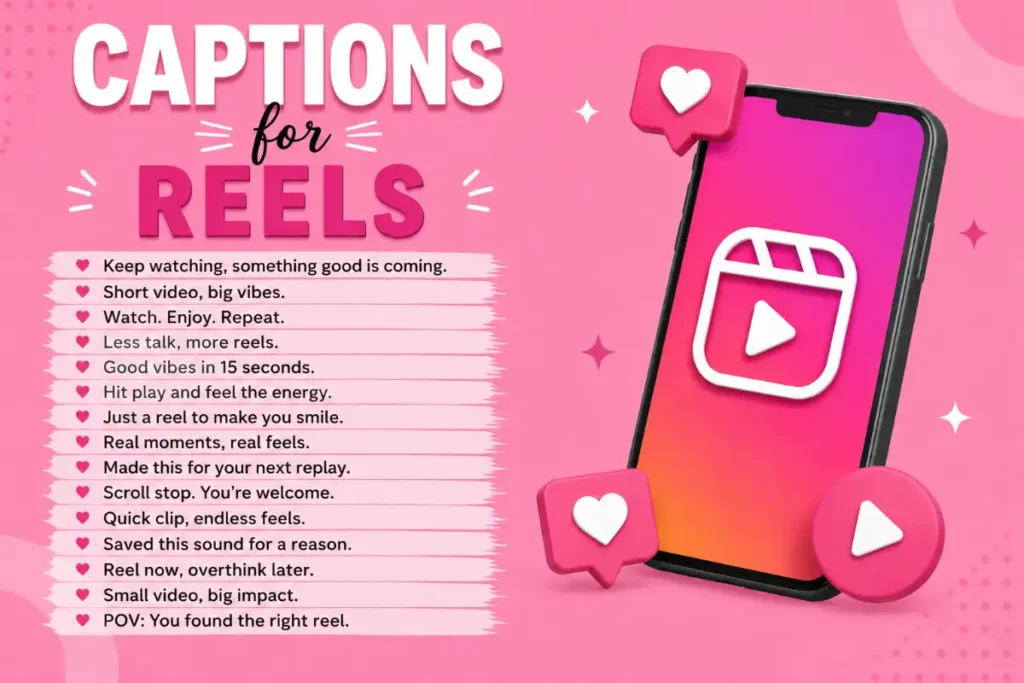
For Instagram Reels and TikTok, captioned can refer to two different things. First, it may describe the written copy accompanying the post. Second, it may refer to synchronized text that represents speech within the actual video.
Because both meanings occur frequently, context becomes especially important.
For example:
- The creator captioned the Reel with a quick recipe explanation.
- She captioned her TikTok with details about the challenge.
- The talking video included captions so viewers could read the speech.
- He wrote the Reel caption before sharing it.
- The creator added captions throughout the tutorial.
- They captioned their travel clip with the destination.
- The short video displayed captions for the conversation.
- She added extra context to the caption of her behind-the-scenes Reel.
- The storytime TikTok included clear on-screen captions.
- He changed the caption when reposting the clip.
Therefore, someone saying “caption the Reel” may mean write its post caption. On the other hand, saying “make sure the Reel is captioned” may refer to readable on-screen speech.
The surrounding conversation usually reveals which meaning applies.
Captioned Meaning for Accessibility ♿
In accessibility contexts, captioned has a more specific meaning. It means that text represents audio information so viewers do not need to depend entirely on sound.
Captions can communicate spoken dialogue, speaker changes, music cues, alarms, laughter, applause, and other meaningful sounds. As a result, viewers can follow important information even when they cannot hear or choose not to use audio.
For instance:
- The lecture included captions throughout the session.
- The presentation displayed readable text for the speaker’s words.
- A captioned video allows viewers to follow dialogue in text.
- The training team added captions throughout the recording.
- Captions clearly identified different speakers in the interview.
- The announcement included captions for spoken information.
- The production team captioned the educational lesson before publication.
- The livestream displayed captions throughout the broadcast.
- The program included text for meaningful sound cues.
- Viewers could follow the captioned recording without relying entirely on audio.
Similarly, captions differ from a transcript. A transcript generally provides a separate written record of spoken material, whereas captions appear at relevant moments during playback.
As a result, captions stay connected to the timing of the video or audio.
Closed-Captioned Meaning on TV 📺
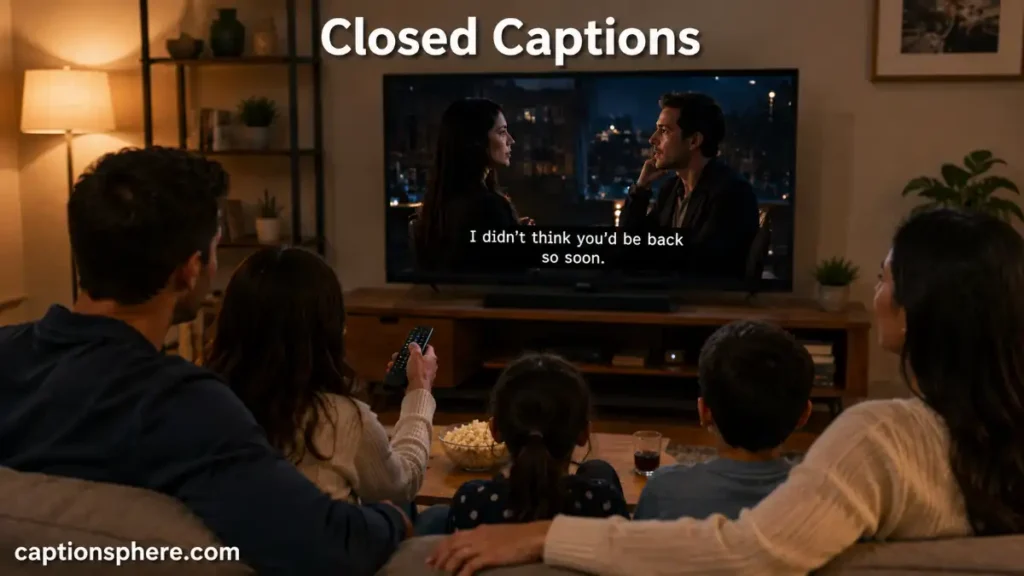
Closed-captioned means that captions are available and viewers can normally switch them on or off. You will commonly encounter this term on television programs, streaming services, movies, online videos, and other digital media.
Closed captions may display dialogue, identify speakers, and describe meaningful sounds that help viewers understand a scene.
For example:
- The television program offered closed captions.
- We turned on closed captions during the movie.
- The broadcaster provided captions throughout the program.
- She prefers watching television with captions enabled.
- The streaming episode included optional captions.
- I switched captions on because the dialogue was difficult to hear.
- The movie offered a closed-caption option.
- We checked whether the program supported captions.
- Captions made the episode easier to follow in a noisy room.
- The viewer enabled closed captions through the playback menu.
Importantly, the word closed does not mean unavailable or restricted. Instead, it means viewers generally have control over whether the captions appear.
Open-Captioned Meaning on Screen 🎞️
By contrast, open-captioned content displays captions that normally remain visible to everyone. Individual viewers generally cannot turn them off because the text forms part of the displayed content.
You may encounter open captions at cinema screenings, presentations, public events, social videos, and other forms of visual media.
For example:
- The theater offered an open-captioned screening.
- Everyone could see the captions on the screen.
- The video displayed open captions throughout playback.
- The words stayed visible without requiring any settings.
- The event used an open-captioned presentation.
- We selected an open-captioned showing of the film.
- The creators built the captions directly into the displayed content.
- Viewers automatically saw the text during playback.
- Captions remained visible throughout the presentation.
- The open-captioned version required no caption settings.
So, the simplest distinction is this: closed captions are usually optional, while open captions normally remain visible.
Captioned Meaning in News and Publishing 📰

In newspapers, magazines, books, news websites, archives, museums, and other publications, captioned means that someone has supplied a visual with explanatory or identifying text.
In this context, accuracy matters. A caption may tell readers who appears in an image, where the photographer took it, when the event happened, or what the visual represents.
For instance:
- The editor captioned the newspaper photograph with the location.
- The publication added clear captions to each image in the feature.
- The editor captioned the photograph with identifying details.
- The publication included the date and place beneath the picture.
- The magazine featured several captioned photographs.
- The archivist added historical information beneath an old image.
- The editor captioned the news photograph to identify the people shown.
- Every illustration included a concise caption.
- The website included captioned images throughout the article.
- The editor checked each photograph for caption accuracy.
Another useful related word is miscaptioned. It means that someone has given an image or other visual an incorrect or misleading caption.
For example, a newspaper might correct a miscaptioned photograph after discovering that the original caption named the wrong person, location, or date.
Captioned Meaning in Everyday English 🔤
Grammatically, captioned is the simple past tense and past participle of the verb caption. Its pronunciation is approximately KAP-shuhnd.
Related forms include:
caption, captions, captioning, captioned, uncaptioned, and miscaptioned.
Understanding these forms makes it easier to distinguish the action from the actual written text.
Consider these examples:
- She captioned the photograph yesterday.
- He has captioned all the images already.
- The editor added individual captions to the photographs.
- I captioned the post before publishing it.
- They had captioned the video before the event.
- The editor carefully captioned every illustration.
- We captioned the pictures with short descriptions.
- Someone incorrectly captioned the photograph.
- She is captioning the final set of images.
- The uncaptioned photo still needs descriptive text.
Additionally, several common grammatical patterns appear with this word.
Captioned with:
She captioned the photo with the location.
Captioned as:
The editor captioned the image as a city view.
Captioned by:
The photograph was captioned by the editor.
Although active voice usually sounds more direct, passive constructions such as the photograph was captioned remain grammatically correct and useful when the person performing the action does not matter.
Captioned Meaning With Examples 📚
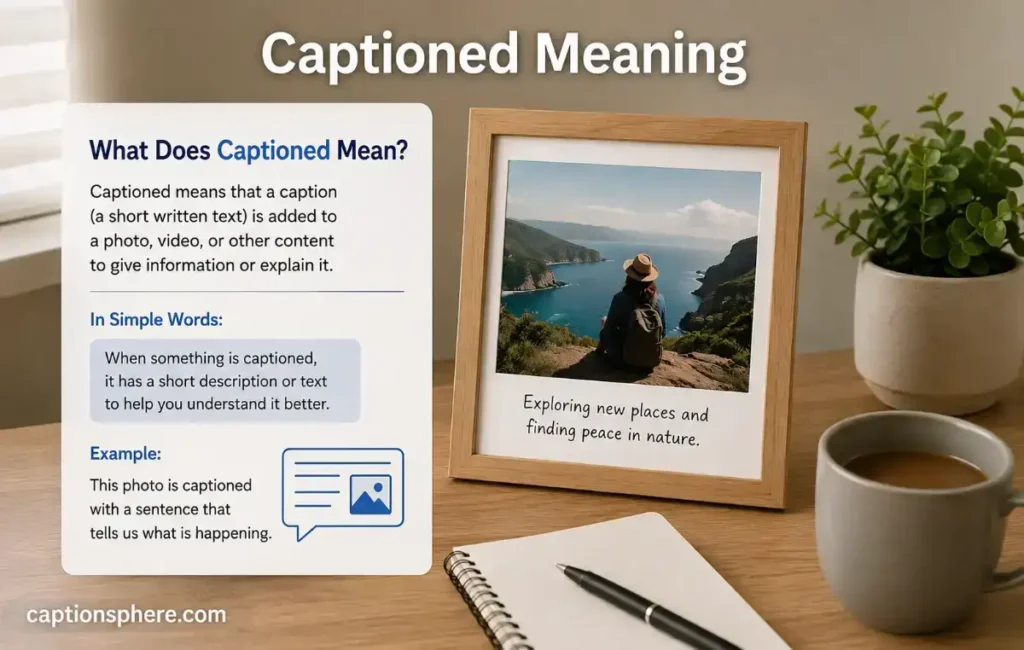
Real sentences make the captioned meaning easier to recognize across different situations. Some examples involve social post copy, while others involve photographs, publishing information, memes, or synchronized video text.
For example:
- She captioned her vacation photo with the beach name.
- The video included captions so viewers could read the conversation.
- He captioned his birthday post with a thank-you message.
- The editor added clear captions to every photograph in the article.
- The documentary included readable captions for dialogue.
- She captioned the group selfie with an inside joke.
- They added dates and locations to their travel photo captions.
- I captioned my Instagram post before sharing it.
- The creator added captions to make the educational clip easier to follow.
- The family album contained carefully captioned photographs.
Although these examples cover different situations, the central idea stays the same: captioned describes something that has received caption text.
The purpose, style, and placement of that text simply change according to the medium.
Captioned Meaning for Content Creators 🎙️
For content creators, captioned can describe either copy attached to a social post or readable text representing audio within a video.
Creators working with YouTube, TikTok, Instagram Reels, interviews, tutorials, podcasts, product demonstrations, and educational content often use both types.
For example:
- I captioned the Reel with a quick tutorial explanation.
- She captioned her product post before publishing it.
- The creator added captions for the spoken dialogue.
- He captioned the behind-the-scenes post with extra details.
- The editor added captions to the interview clip before it went live.
- She captioned her travel Reel with the destination and date.
- The talking-head video included readable captions.
- I captioned the carousel with details about each picture.
- The creator added step-by-step captions to the demonstration video.
- His short-form video included captions for viewers watching without sound.
Therefore, creators can use one simple distinction:
A post caption accompanies the post, whereas video captions represent audio within the content.
Understanding this difference can also help creators communicate more clearly with editors, social media managers, and video production teams.
Captioned Meaning in Memes 😂
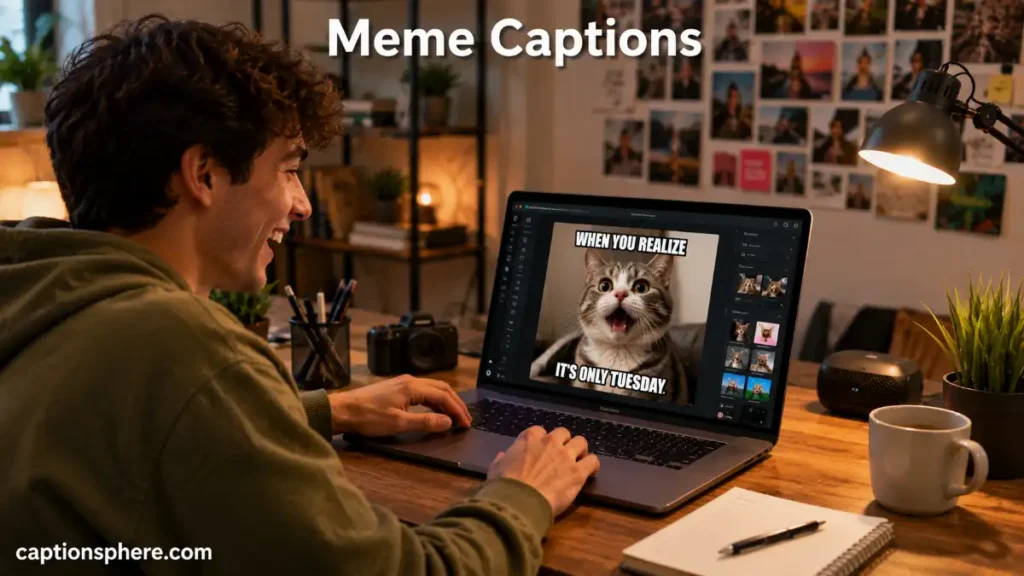
In meme culture, captioned usually means that someone has added humorous, sarcastic, relatable, or explanatory text to an image, GIF, screenshot, or video.
Unlike a traditional photo caption, meme text may completely change how viewers interpret the visual. For instance, an ordinary picture of a tired cat can become a workplace joke when someone adds text about Monday morning.
Here are some examples:
- She captioned the reaction image with a Monday morning joke.
- She added exactly what everyone was thinking to the meme.
- He captioned the screenshot with a relatable workplace joke.
- The ordinary photo became funny after someone added a caption.
- She captioned the GIF with a reaction to the group chat.
- Someone captioned the cat picture like an exhausted employee.
- He captioned the awkward image with a joke about social situations.
- The meme text gave the facial expression extra context.
- She captioned the photo with an expectation-versus-reality joke.
- Someone turned the screenshot into a punchline by adding a caption.
In other words, meme captions do more than describe what appears in an image. Instead, they often create the joke itself.
Conclusion
The captioned meaning centers on one simple idea: someone has provided something with a caption or accompanying written text. However, the exact purpose of that text changes depending on whether you are looking at a social post, photograph, meme, video, television program, publication, or accessibility feature.
For example, a photo caption may identify a person, location, or event. Meanwhile, video captions can represent dialogue and meaningful sounds. On social media, a caption may tell a story, express an emotion, add humor, or provide context.
Therefore, when you encounter the word captioned, look at the platform, visual content, audio, and surrounding sentence. These clues usually reveal the intended meaning quickly.
Finally, knowing related terms such as subtitles, transcripts, open captions, closed captions, uncaptioned, and miscaptioned makes the word easier to understand and use accurately.
Frequently Asked Questions
What Does Captioned Mean?
Captioned means that someone has supplied something with a caption. The caption may describe a photograph, accompany a social media post, or represent spoken dialogue and meaningful audio in a video.
Therefore, the exact meaning depends on what kind of content someone has captioned.
What Is the Captioned Meaning in English?
The captioned meaning in English is generally “provided with a caption.” Captioned is the past tense and past participle of the verb caption.
For example, you can caption a photograph, illustration, social media post, video, television program, or other visual content.
How Do You Pronounce Captioned?
Captioned is pronounced approximately KAP-shuhnd. The base word caption sounds roughly like KAP-shuhn.
In normal speech, the ending of captioned does not usually create a separate full syllable. Thinking of it as caption + d can make the pronunciation easier to remember.
Is Captioned a Verb or an Adjective?
Captioned comes from the verb caption. It can function as the simple past tense, as in She captioned the photo, or as a past participle, as in The editor has captioned the photo.
Additionally, it can describe something that contains captions, such as a captioned video or captioned photograph.
Is Captioned Slang?
No. Captioned is standard English rather than slang.
People commonly use the word in journalism, publishing, social media, television, education, video production, accessibility, and everyday conversation.
However, the type of caption involved can change according to the platform or medium.
What Is the Difference Between Caption and Captioned?
A caption is the actual text that accompanies a photograph, illustration, social post, or other visual.
By contrast, captioned describes the action or result of adding that text.
For example, Mountain morning can serve as a caption, while She captioned the picture “Mountain morning” describes the action.
Is Captioned the Same as Subtitled?
Not exactly.
Subtitles commonly represent spoken dialogue and often translate speech from one language into another. Accessibility captions may go further by identifying speakers and communicating meaningful sounds.
However, platforms sometimes use these terms differently, so the exact distinction can depend on the service or media format.
What Is the Difference Between Captions and Transcripts?
Captions generally appear in synchronization with audio or video. In other words, viewers see the relevant text as the corresponding dialogue or sound occurs.
A transcript, by contrast, usually provides a separate written record of spoken material.
Therefore, both convert spoken information into readable text, but they present that information differently.
What Does Closed-Captioned Mean?
Closed-captioned means that captions are available and viewers can generally turn them on or off.
You commonly see closed captions on television programs, movies, streaming services, and video players. They may represent dialogue, identify speakers, and communicate meaningful sounds.
What Does Open-Captioned Mean?
Open-captioned content displays captions that normally remain visible to everyone watching.
Unlike closed captions, viewers generally cannot switch open captions off individually. For example, a cinema may offer an open-captioned screening where every viewer sees the caption text on the screen.
What Does Miscaptioned Mean?
Miscaptioned means that someone has given an image, video, or other visual an incorrect or misleading caption.
For example, a news organization might miscaption a photograph by identifying the wrong person, date, or location. Because captions provide important context, publications often correct these mistakes when they discover them.
What Are Synonyms for Captioned?
Depending on the context, related words include labeled, described, annotated, titled, identified, subtitled, and explained.
However, these words are not exact synonyms in every situation. For instance, a label may simply identify something, whereas a caption can provide a fuller description, explanation, or context.
1 thought on “Captioned Meaning: Definition, Examples, and Everyday Uses”